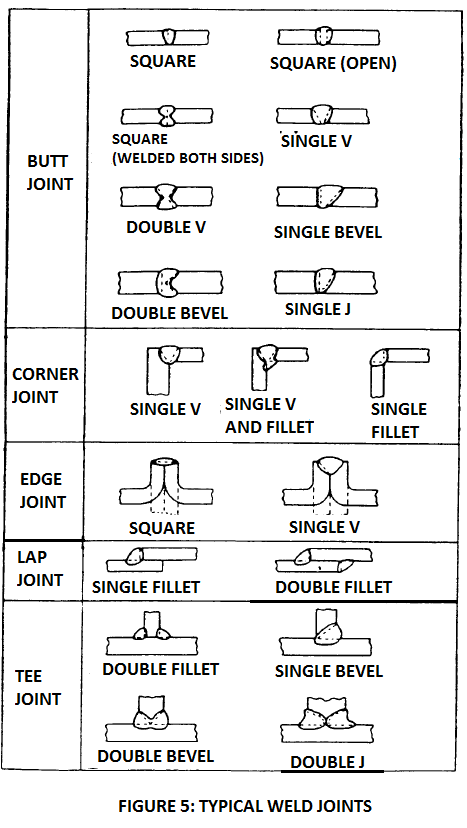
It is important to distinguish between the types of joints and the types of welds in welding. Both are not same. We shall see the difference in this article. Both the weld as well as the joint must be stated to completely describe the weld joint. There are many different types of welds, which are best described by their shape when shown in cross-section. In this article, we shall see about various types of welds.
Types Of Welds
The various types of welds are: fillet weld, groove weld, surfacing weld, plug weld, slot weld, flash weld, seam weld, spot weld, and upset weld. Let us see in brief about each of them.
Fillet Weld
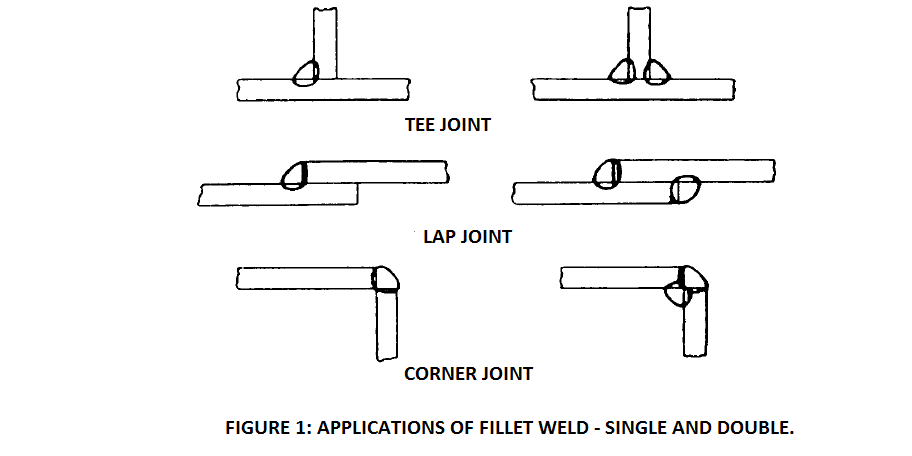
The most popular weld is the fillet weld, named after its cross-sectional shape. Fillet welds are shown in figure below.
Groove Weld
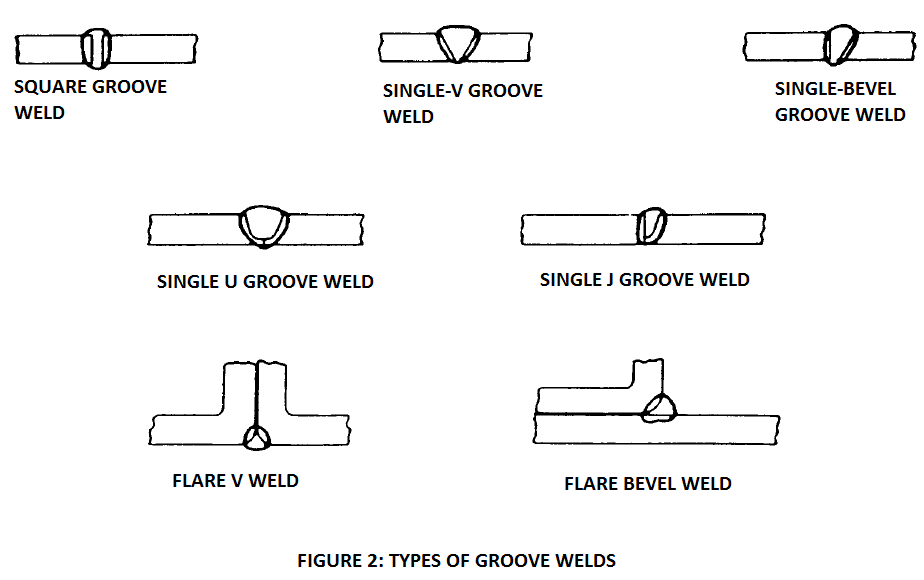
The second most popular is the groove weld. There are seven basic types of groove welds, which are shown in figure below.
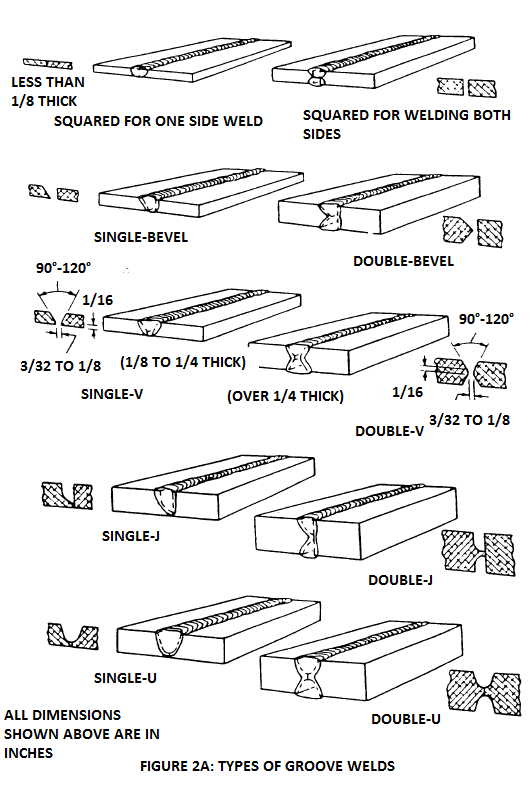
Below is an isometric view of various types of groove welds.
Surfacing Weld
As the name indicates, these welds are simply depositions of weld metal on the surface of base metal. This kind of surfacing is generally done to obtain a corrosion resistant surface on a metal surface, or to obtain a hard-facing surface that is resistant to wear and tear.
Sometimes, the surfacing is in the form of buttering – done to make one surface compatible for welding with another part. Sometimes surfacing is done to build up a surface to restore its’ thickness.
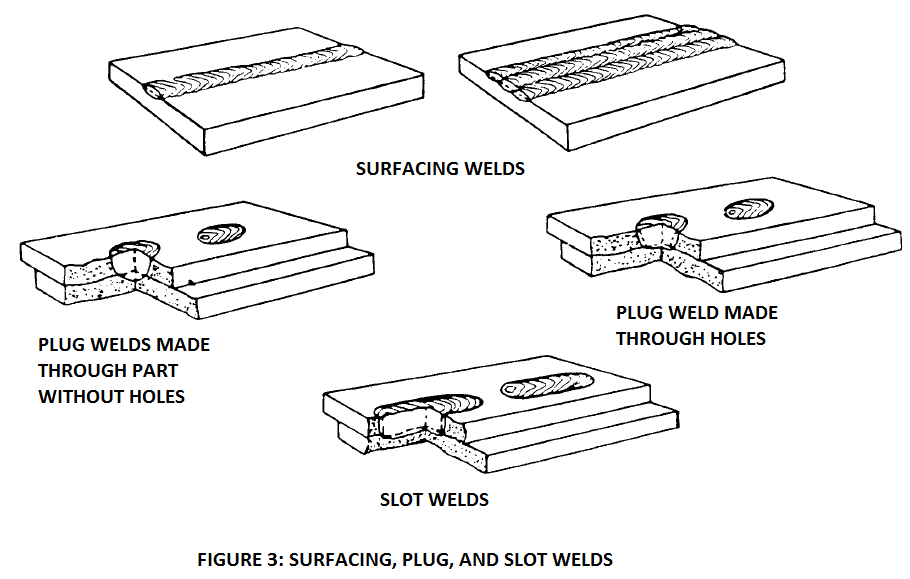
Plug Weld
See the above figure. As the name suggests, these welds are meant to plug a hole. One plate is kept over another, and a hole exists in one of the plates. The weld is deposited in this hole to plug it. The walls of the hole are straight. Although, it is not necessary. The walls can be inclined too.
The hole is generally filled fully, although this is not necessary either. The hole can be partially filled too, as desired by the designer. Plug welds are sometimes considered as a replacement for rivet joints.
Slot Weld
Slot weld is also shown in the figure above. It is quite similar to the plug weld, except that the hole is not circular, it is an elongated hole in the shape of an ellipse. This elongated hole is filled with weld metal, thus joining the part containing the hole to the second part that is exposed through the hole.
Like plug weld, the hole may be partially filled or completely filled.
Flash Weld
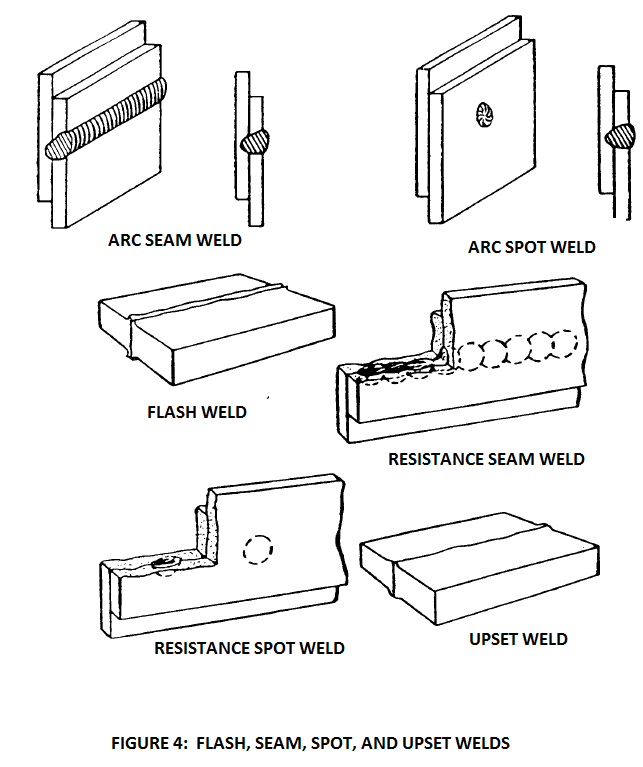
In this type of weld, the two parts to be joined are kept at a predetermined distance to each other, and a electric current is passed. The small gap between the parts gets ionized due to the high voltage difference, and offers resistance to the current flow. Due to this resistance, heat gets generated, and the surface of both the parts gets melted.
When this happens, both the parts are pressed against each other with force. This achieves the weld.
Seam Weld
This is a type of weld produced by resistance welding. Two sheets are pressed against each other between two wheels. During the welding, the work-pieces roll between the two wheels. The wheels have a current flowing between them.
The electrical resistance posed by the work-pieces generates heat between the two parts. This heat melts the part surfaces facing each other at the inside at the point of contact of wheels, and a weld gets created.
As the wheels roll on, a seam of weld gets thus created along the length. Hence the name seam weld.
Spot Weld
Spot welding is a variation of seam resistance welding. Instead of a length, the weld is in the form of a nugget localized at a spot. Hence the name spot weld.
Upset Weld
An upset weld is similar to flash weld. Heat for welding is obtained through resistance offered by the work-piece to the flow of current. However, the weld is obtained not simultaneously over the entire area, but progressively along a joint. Pressure is applied between the abutting parts to achieve the weld.
What Type Of Weld Is Suitable For A Given Weld Joint Type?
As we have seen above, a joint and weld are not the same thing. The weld and joint combine together to make a weld joint. However, not all weld types can be combined with all joint types. The following table tells what welds can be combined with what joints to produce a weld joint.